
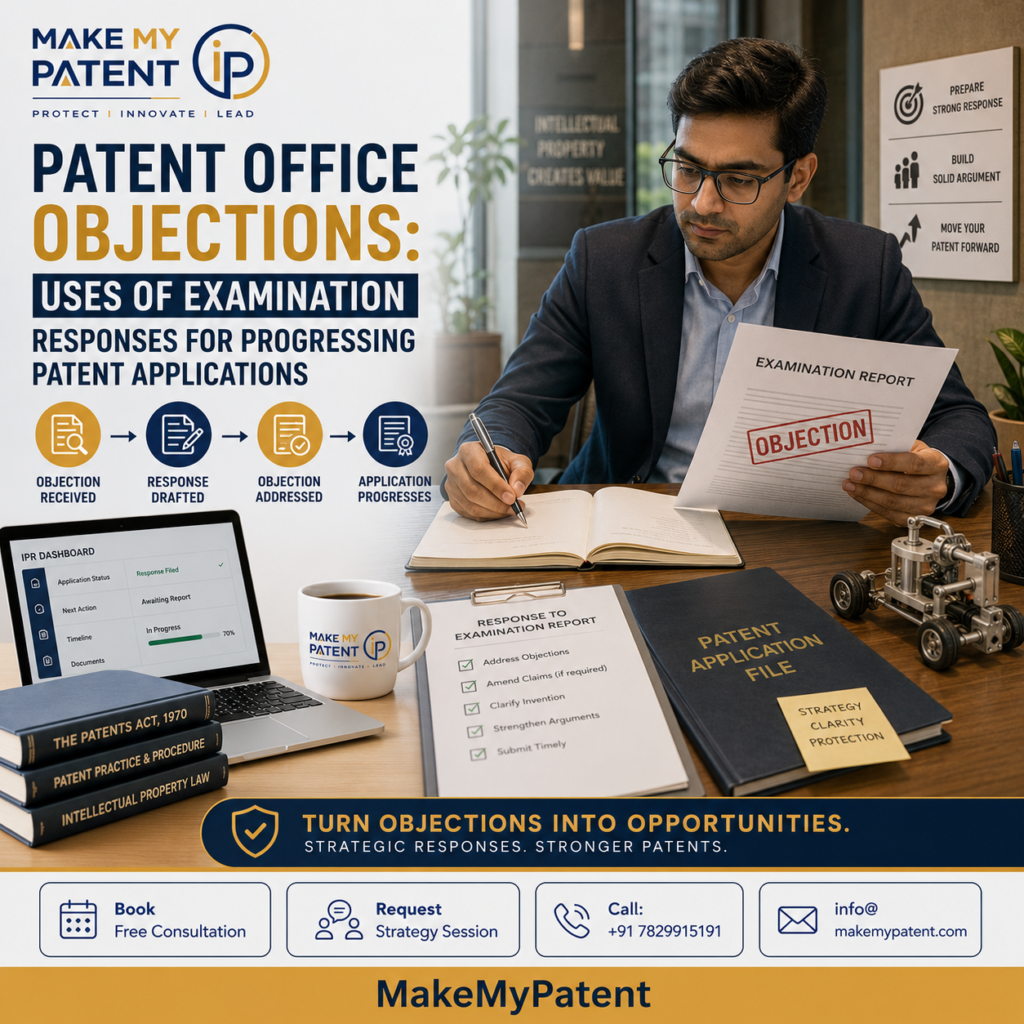
For many startups, innovators, and businesses, filing a patent application marks the culmination of years of intensive R&D. Consequently, founders view this event as a major milestone in company growth. However, many founders feel surprised when the Indian Patent Office issues a formal communication raising specific concerns years after filing.
If you received a First Examination Report (FER) detailing a patent office objection, do not panic. Importantly, an objection does not mean a rejection; rather, it represents a routine step in the patent lifecycle. Statistically, almost every application globally faces some form of examination objection before grant. Therefore, developing a precise, techno-legal examination response offers the best way to progress your application.
Whether you manage a tech startup in Bangalore or lead a global enterprise, understanding patent office objections remains essential. Furthermore, pairing a defensible IP moat with an aggressive digital marketing strategy ensures your firm maintains a dominant market edge. This guide explains what objections mean, how to resolve them, and how expert support accelerates your patent grant.
What Are Patent Application Objections?
After you file a Request for Examination (RFE), a Controller at the Indian Patent Office reviews your application and issues a First Examination Report (FER). In this report, the Controller details technical comments and cites specific sections of the Patents Act, 1970.
Examiners frequently raise the following common objections:
- Lack of Novelty: The examiner considers your invention too similar to existing technologies. Consequently, they classify your invention as not novel.
- Lack of Inventive Step: The examiner may agree that your concept is new. However, they argue that the solution remains obvious to a person skilled in the art.
- Non-Patentable Subject Matter: The examiner classifies your innovation as a business method, computer program per se, or mathematical formula, which Section 3 of the Patents Act explicitly excludes.
- Formal and Drafting Defects: The application contains unclear technical drawings, missing signatures, or ambiguously drafted claims.
Receiving an FER simply indicates that the examiner requires further technical and legal clarification. Therefore, your patent examination response must outline detailed legal justifications explaining why your invention deserves a patent grant.
Who Needs Help with an Examination Response?
Navigating patent prosecution requires immense precision. Consequently, attempting a do-it-yourself approach carries heavy risks. Professional legal assistance helps key stakeholders effectively:
- Founders and Startups: Startups rely heavily on patentable IP to attract venture capital. Consequently, an unaddressed objection can significantly diminish company valuation.
- Inventors and Innovators: An improper FER response can cause the complete loss of valuable patent rights.
- Researchers and Academic Institutions: Experts accurately translate complex scientific findings into legally defensible patent claims.
- MSMEs and Enterprises: Businesses across Bangalore, Karnataka, and India resolve objections to maintain their competitive edge.
- Product Teams: Engineering teams ensure that approved claims cover the exact product entering the commercial market.
If you recently received an FER, you can schedule a free consultation with our experts to review the examiner’s concerns.
Key Documents Needed to Prepare a Response
A registered patent agent requires specific documents to draft an effective examination response:
- The First Examination Report (FER): The official document containing the patent office objections.
- The Cited Prior Art: Specific patents, journals, or papers that the examiner cited to challenge your invention.
- The Complete Specification: Your original application document, including background, detailed descriptions, and filed claims.
- Technical Inputs from the Inventor: Side-by-side technical comparisons highlighting the exact inventive differences of your technology.
The Step-by-Step Process for Filing an FER Response in India
Filing a successful FER response requires strategy and techno-legal precision. Therefore, professional patent agents follow this structured process:
- Comprehensive FER Analysis: First, your patent agent thoroughly analyzes the objections and studies all cited prior art documents.
- Strategy Alignment: During a strategy session, the agent gathers technical insights from the inventor. Consequently, they isolate the unique features that distinguish your invention from prior art.
- Strategic Claim Amendments: To overcome objections, agents frequently amend the claims to a narrower, more precise scope. As a result, the amended claims bypass cited prior art while retaining broad commercial protection.
- Drafting the Response: The agent prepares a formal legal document addressing every objection point-by-point with technical facts and statutory law.
- Official Submission: The agent submits the completed response to the Indian Patent Office within the mandatory timeframe (typically 6 months from the FER issuance date).
- Patent Hearing Representation: If the examiner requires further clarification, the patent office schedules a hearing. Consequently, your agent presents oral arguments and legal evidence directly to the Controller.
Common Mistakes to Avoid
When responding to a patent application objection, avoid these critical errors:
- Missing Statutory Deadlines: Applicants have 6 months to submit an FER response (extendable by 3 months with official fees). Failing to file within this statutory window permanently abandons the application.
- Arguing Without Amending: Relying solely on stubborn arguments without adjusting claim language often leads to rejections. An experienced agent knows how to make subtle claim adjustments to secure a grant.
- Presenting Emotional Arguments: Examiners evaluate applications strictly using technical facts and statutory law. Therefore, emotional statements about how hard you worked carry zero legal weight.
- Attempting DIY Responses: Patent prosecution involves complex legal proceedings. Unrepresented inventors frequently invalidate their own applications by making damaging admissions.
The Benefits of Professional Patent and IP Support
Crafting an examination response demands sharp legal reasoning and technical clarity. Therefore, partnering with professional agents provides a distinct competitive advantage.
Registered agents understand examiner expectations. Consequently, they translate frustrating legal rejections, draft strategic claim amendments, and defend your business interests during formal hearings. Utilizing an advanced IP strategy dramatically improves your chances of overcoming objections and obtaining an issued patent.
To see how our advanced workflows can safeguard your invention, visit our services page today.
Why Choose MakeMyPatent?
MakeMyPatent transforms intellectual property into powerful corporate assets. With over 20 years of experience, we help innovators across Bengaluru and worldwide navigate every stage of the IP lifecycle.
Located in Jayanagar, Bengaluru, our team provides end-to-end support for patents, trademarks, copyrights, and global PCT filings. Furthermore, we leverage advanced AI technology alongside deep legal expertise to conduct accurate prior art searches and draft resilient examination responses.
Do you have questions about an FER? Contact our team via WhatsApp to discuss your case directly with a patent specialist.
Frequently Asked Questions (FAQs)
1. Does receiving a patent office objection mean my application is rejected?
No. An objection in an FER represents a routine step in examination. Specifically, it means the examiner requires additional technical clarification or minor claim adjustments before granting the patent.
2. What happens if I fail to respond to the FER on time?
You have 6 months to file a response, with a possible 3-month extension upon request. Consequently, if you fail to submit a response within 9 months, the patent office deems your application legally abandoned.
3. Can I submit an FER response without hiring a patent agent?
Yes, applicants hold the legal right to respond independently. However, hiring a registered patent agent remains strongly recommended due to the complex legal and technical standards required.
4. How long does prosecution take after filing an FER response?
After submission, the examiner reviews your response. If satisfied, they may issue the patent grant within a few months. Otherwise, if objections remain, they schedule a formal hearing, which adds several months to prosecution.
5. What is a patent hearing?
If the examiner remains unconvinced by the written FER response, they issue a hearing notice. Consequently, your patent agent attends a formal meeting (often via video) to present verbal arguments and refine claims.
Disclaimer: This blog provides general educational information and does not constitute formal legal advice. Please consult a registered patent practitioner regarding your specific invention or IP requirements.
🚀 Progress Your Patent Application Today
Don’t let a First Examination Report delay your commercial success. Schedule a free consultation with MakeMyPatent for expert FER analysis, claim drafting, and hearing representation.
- 🌐 Website: makemypatents.com
- 📞 Call Us: +91 7829915191
- ✉️ Email Us: info@makemypatent.com