
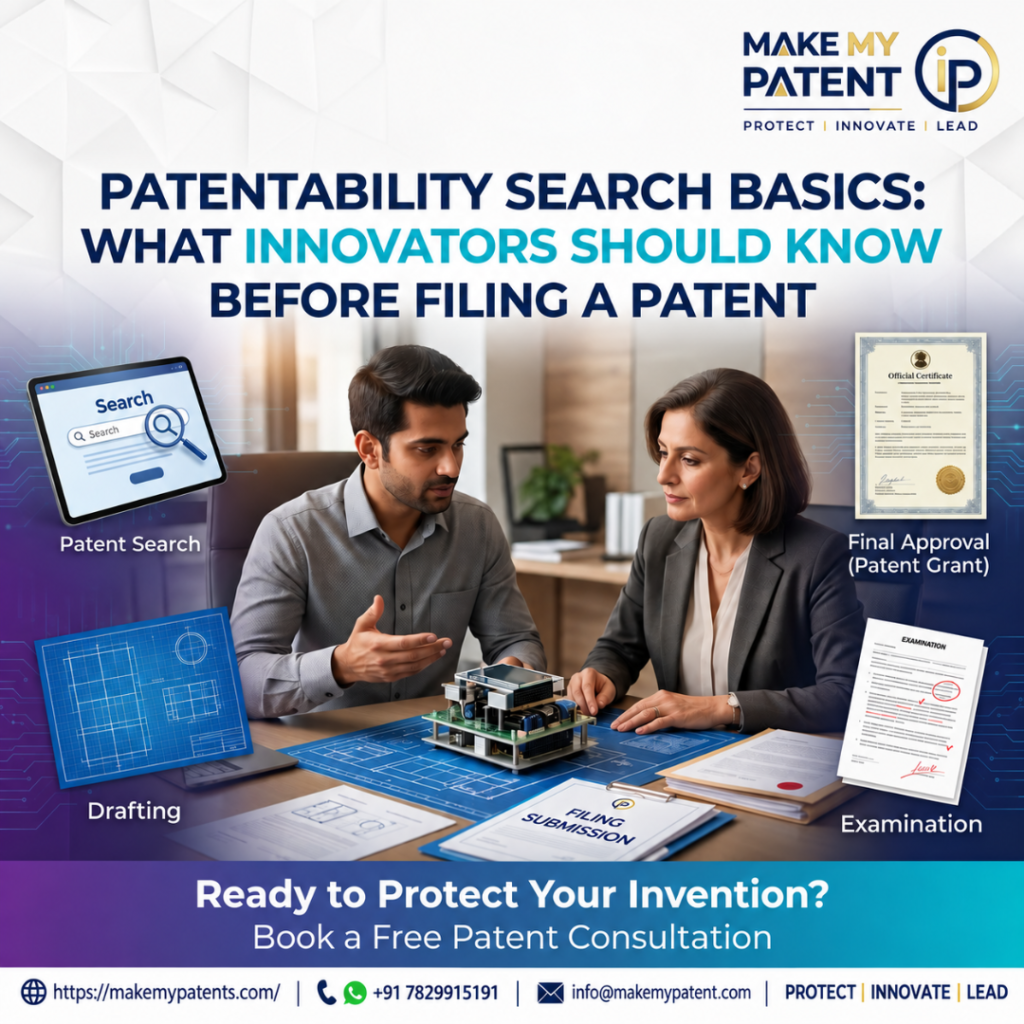
Introduction:
Patents play a crucial role in protecting inventive intellectual property. For inventors and businesses, patents are valuable assets and can significantly influence the market value of a company. Obtaining a patent, however, is costly and time-consuming. It is important to assess if an idea is worth protecting by patent. An invention can only be patented if it is novel and inventive.
An examination of patentability helps answer these questions. The objective of an evaluation of patentability is to determine if an invention is patentable. This analysis is commonly performed by comparing the technology to previously disclosed ideas and publications to determine if the idea or technology is truly novel and inventive.
The Indian patent regime prescribes that an invention be novel and involve an inventive step and further be capable of industrial application. The concept or idea should also not be against any of the principles that are vested in the Patents Act and consequently be unpatentable.
In view of the above, it is prudent that the assessment be performed before a patent application is prepared. In India, and more specifically Bangalore, this assessment can be performed prior to preparation of the patent application.
The following will be evaluated during the search process:
Indian and international patents and patent applications
Other scientific and technical information
Product information
Relevant literature
Know-how
The search process will consider the field of the technology, the competitors, and the market.
The focus is to find publications related to the technology of the invention. The search will look beyond the title and/or the abstract of the publication.
The Indian Patent Office states that in determining novelty, an applicant should consider whether the invention has been published or offered for sale before the priority/filing date. It is relevant to consider all documentation, whether published or not, that is accessible to the public.
A prior art search, therefore, may give more relevant information than a general internet search.
Understanding Patent Novelty and Inventiveness is Important before Filing
Understanding Patent Novelty
Prior to filing for a patent, an applicant must understand whether the invention is novel.
A prior art search will help the applicant decide on patentability. The search may help assess the combination of features of the invention and determine whether an inventive step is present.
Understanding Patent Inventiveness
An invention may be novel, but it may be considered obvious based on the prior knowledge of a person skilled in the field.
- Define Meaningful Technical Advance
A search pulls together information that helps to pinpoint relevant prior art. Based on the search results, a patent professional can focus on the aspects of an invention that are not readily apparent to the public. If there are obvious aspects of the invention, the patent professional may not be able to draft claims that protect the entire scope of the invention. However, the search can help the patent professional draft a claim to cover the prominent aspects of the invention.
- Define Meaningful Disclosure
Prior art can be uncovered by conducting a search. Sometimes there are public disclosures of some aspects of an invention. In these cases, the focus of the patent professional can be directed toward the aspects of the invention that are not appreciated by the public. The patent professional can then draft a claim and supporting disclosure to cover the valuable aspects of the invention.
- Define Meaningful Filing
An invention can be improved based on the search results. The search also helps innovators decipher the scope of claim they are willing to defend. A search can also assist in developing strategies for protecting other forms of intellectual property.
Who Can Benefit from a Patent Search?
A patent search can assist individuals that want to file their first patent, especially individuals that are new to the patent process, for example, students and faculty members and researchers. It can also assist professionals and businesses that want to commercialize a product based on R&D.
What Is Needed to Conduct a Patent Search?
The result of a patent search is only as good as the information provided concerning the invention. It is advised that applicants provide as much detail as possible to assist the patent search professionals.
The ideal request would include:
- Invention Disclosure
Provide a description of the problem and solution with as much detail as possible.
- Key Technical Differentiators
Describe the aspects of the solution that make it technically different from the existing solutions.
- Diagrams or Flowcharts
Include diagrams or flowcharts, if helpful in describing the solution.
- Alternative Language
Include other language that describes the same thing.
- Technical Documents
Include technical documents that may be helpful in providing context.
A patentability search is conducted to understand if an invention is novel and/or non-obvious in a given jurisdiction. The process may include the following:
I. Discussion
The invention is discussed, and the technical field, the public problem solved by the invention, and the advantages of the invention are identified.
II. Defining the Scope of the Search
The field of search is defined by classifications, keywords, synonyms, the names of the organizations where the invention was made, the names of the persons who made the invention, the competitors, and other fields of technology.
III. Search for Previous Public Disclosures
Relevant prior art is identified by searching through patents and other publications.
IV. Analysis of Disclosures
Disclosed inventions are analyzed to understand what features of the invention were disclosed.
V. Novelty and Obviousness
The results of the search are analyzed to understand if the invention is novel and/or non-obvious. In Indian patent practice, these two analyses are considered separately.
VI. Preparation of a Search Report
The features that distinguish the invention are analyzed, and strategies for protecting the invention are listed.
VII. Develop the Filing Strategy
The results of a novelty search can help an inventor and patent professional decide on the best approach to proceed with regard to drafting the application and making strategic decisions about patent claims. Results may also indicate the need for further research, experimentation, and/or testing. In some cases, the search results may inform an inventor’s strategic decision-making about the filing and/or prosecution of a patent application in a foreign jurisdiction.
What About AI Patent Search?
AI can supplement patent search by revealing semantically related documents.
In several scenarios, AI can complement and expedite patent search and analysis, especially in a field involving a large body of literature.
Avoiding Common Patentability Search Mistakes
- Avoiding Thorough Search
A limited search may be helpful to familiarize oneself with an area of technology and identify a starting point for further search. However, searching patent literature alone may not help understand the state of technology.
- Avoiding Broader Search
The keyword search may uncover some documents relevant to the search, but it may not cover the entire body of relevant patent literature. Alternatively, a search may be specific to the preferred terminology of an inventor.
A search may help identify relevant literature and/or practice outside India.
A search may help identify relevant prior art, but analysis of whether the prior art negates the novelty of an invention is beyond the scope of AI.
Conducting a search should assist the understanding of the art and assist in determining the best strategy for the drafting and filing of the application.
Though patent searches can be done by attorneys or agents, making the right judgment about inventive step and/or novelty can be difficult. Identifying the true inventive step may require some level of experience in the field. More often than not, an in-depth understanding of the field may provide insights on how to differentiate an invention. This understanding may assist in strategic patent drafting and enable a person to identify the implications of an invention over the prior art.
According to the company website, MakeMyPatent states it provides patentability searches, patent drafting and filing, post-filing responses, and other IP services and strategies.
MakeMyPatent claims to provide a host of IP services and has experience working with clients ranging from researchers to multinational companies. The website highlights a number of services, including AI-based patent search and drafting, global patent filings, and other IP services. The website states that the firm has over 21 years of experience.
- Frequently Asked Questions
- What is a patentability search?
A patentability search is an analysis of a given invention to determine the presence or absence of prior art and to assess the invention’s novelty and obviousness.
- Is it essential to perform a patentability search?
While it is not mandatory to perform a patentability search, it is beneficial, as it assists in devising a filing strategy and drafting the claims of the invention.
- What is the difference between a prior art search and a patentability search?
In a prior art search, the objective is to find any sort of publication that discloses the invention, and in a patentability search, along with prior art, other patent criteria such as novelty and obviousness are assessed.
- Can AI patent search tools replace patent professionals?
AI has the potential to revolutionize document retrieval and semantic searching and can be used for large-scale analysis of patent data. However, interpreting prior art requires the experience and judgment of a patent professional.
- Does a positive patentability search equal patent issuance?
Not at all. There are a number of reasons a patent may still be refused despite a positive patentability search. A patent application is just the first step in a long and detailed process governed by many provisions of patent law.
Final Thoughts
Coming up with a market strategy for a new technology often means considering how your idea will be adopted. Working backwards can help you better frame your invention to possible obstacles, and make more strategic decisions around patent drafting and filing.
Patentability searches help assess the patentability of an idea or invention. A patentability search is usually the first step towards protecting an invention with a patent. In India, under the applicable laws, before applying for a patent, it is essential for an applicant to ensure that the idea or invention for which patent protection is sought, does not violate any third party’s intellectual property rights. Conducting a patentability search in India helps to evaluate the risk of infringing upon any third party intellectual property rights and aids in taking corrective measures, if any, before filing for patent protection.
Book a Patent & IP Strategy Consultation with MakeMyPatent
Ready to protect your innovation? Book Free Consultation with MakeMyPatent for expert patent filing, patent drafting, patentability search, and IP protection support.
You can also request a Free Patent Strategy Session, Explore Our Services, or WhatsApp us to discuss your invention and filing objectives.
- 🌐 Website: https://makemypatents.com/
- 📞 Call Us: +91 7829915191
- ✉️ Email Us: info@makemypatent.com
Disclaimer: This blog provides general educational information only and does not serve as formal legal counsel. Please address your specific invention or IP requirements directly with a registered patent professional.