
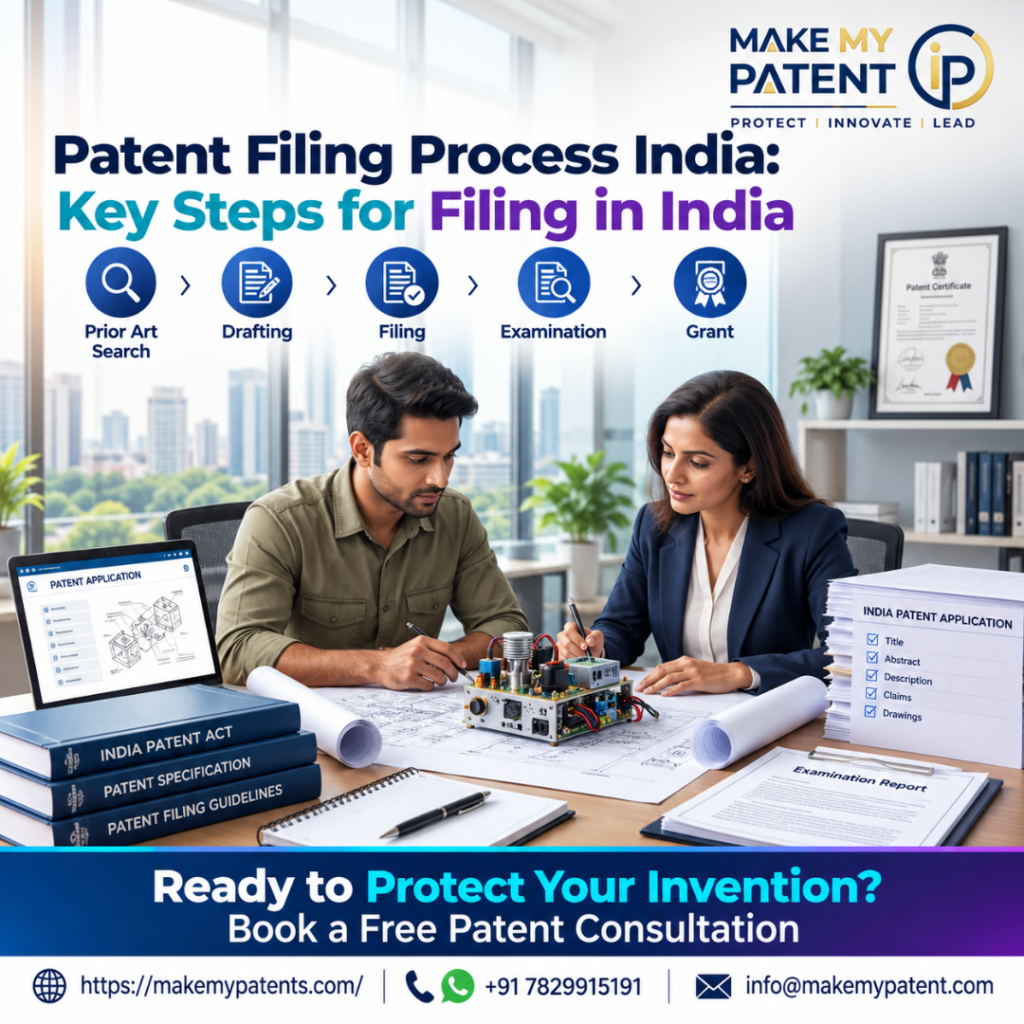
Introduction:
Innovation can provide a competitive edge to a business, but protecting that innovation is as important and requires a well-devised intellectual property strategy. If you are developing a new product or process, improving an industrial process, setting up a technology company or carrying out research, understanding the patent filing process can help to protect your innovation.
The patent filing process in India involves evaluating an invention and deciding the best route for protecting that invention; preparation of the required patent documents; filing the application with the Indian Patent Office; and responding to the requirements of the patent office examination. Each of these steps requires careful consideration to ensure the protection taken is appropriate.
For businesses, researchers, founders, and startups in Bangalore and the rest of India, professional patent assistance can help eliminate errors in documentation and align protection taken to the business’s commercial focus.
MakeMyPatent provides patent services for 21 years and beyond and assists in the patent process using its knowledge of patent laws combined with cutting edge IP and AI technology.
What Is Patent Filing in India?
Patent filing is the process of requesting a monopoly right from the Indian Patent Office to legally protect an eligible invention. In India, an invention has to be novel, involve an inventive step, and be capable of industrial application.
Exclusion of the subject matter from patentability does not preclude its patentability outside India.
An application for a patent does not always guarantee the award of a patent. The application is examined by the patent office to ascertain if it meets the requirements for a patent to be issued.
Who Should Consider Patent Filing?
Patent protection can be useful for:
– Start-ups and founders: Protecting innovative product features, and other valuable technology
– Inventors and Innovators: Developing an adequate filing strategy prior to commercialization of an invention.
– Researchers and Academic Institutions: Protecting eligible research results and promoting technology-transfer.
– MSMEs and enterprises: Creating a long-term business value through protected product differentiation.
– Technology and product development teams: Assessing value of innovations involving hardware, engineering, manufacturing, and eligible software-related product implementations.
Businesses should consider the importance of patent protection in other countries, while planning for their international business expansions, as patent rights are territorial.
Step-by-Step Patent Filing Process in India
Step 1: Evaluate your Invention
Start by describing the problem your invention solves, how it works and what are the key technical features that make it different from existing solutions.
Concentrate on identifying the technical contribution to the field, rather than product features or business concepts. It would help determine the potential of the invention for patent protection.
Prior to public disclosure of your invention, i.e. through a product launch, publication, demonstration, or presentation to investors, it is advisable to consult with a patent practitioner to evaluate the feasibility of filing a patent application.
Public disclosures can compromise the potential of the invention for patent protection.
Step 2: Patentability Search
This search helps identify previous inventions that are alike or similar to yours, by reviewing issued patents, published patent applications, non-patent literature and other available information.
It also helps evaluate whether your invention is novel and/or involves an inventive step.
Competing technology in the field can also be identified through this search and help refine the scope of your protection.
AI-assisted tools can help interpret and analyze large amounts of available information. However, no search can guarantee a patent.
Step 3: Choose Between A Provisional And A Complete Specification
Choosing the right filing route is an important aspect of Patent Filing India.
A provisional specification can be filed if the invention has been developed to a stage where disclosure of the invention is useful and the invention is still under development. The provisional specification enables the applicant to secure an early filing date for the subject matter adequately disclosed in the specification.
A complete specification includes a detailed description of the invention, a set of one or more claims defining the scope of the protection sought, a set of drawings where necessary and an abstract.
An ordinary Indian Application filed with a provisional specification requires a complete specification to be filed within 12 months of the date of provisional specification. Failure to meet this requirement may result in the application being deemed abandoned.
A provisional specification is not a granted patent nor is it a technical disclosure. Features of the invention which may be developed later are not covered by the earlier filing date.
Step 4: Draft The Patent Application
The detailed description of the complete specification should include:
– The title of the invention
– Field and background of the invention
– Summary of the invention
– Detailed description
– Drawings
– Claims
– Abstract
The claims define the scope of the protection. Drafting the claims may not be as simple as it seems. The claims must be precise and drafted in a way to cover the variation of the invention.
Step 5: Complete The Forms, Attach The Required Documents and File The Application
The forms and documents which are required to be attached will depend on the type of application and the circumstances.
The following is a non-exhaustive list of documents commonly filed in a patent application:
– Form 1: Application for grant of a patent.
– Form 2: Provisional or complete specification.
– Form 3: Statement and undertaking regarding corresponding foreign applications, if any.
– Form 5: Declaration as to inventor ship, if needed.
– Form 26: Authorization of patent agent, if any.
– Drawings/abstract/documents supporting applicant’s right to apply, if any.
Other documents may be filed with the application based on the requirements of the applicant.
Applicants have the option to file electronically through the online filing system of the Indian Patent Office, or by other means authorized by the office. Applicants are advised to verify the latest forms and requirements before filing.
Step 6 : Understand the Priority Date and Publication
There are certain situations that allow the applicant to utilize an earlier filing date than the patent application filing date. The relevant date in these situations is called the priority date.
A claim that is supported by a provisional specification may qualify for the provisional application filing date. A claim that is supported by a complete specification and includes new matter may not qualify for the provisional application filing date.
Generally, patent applications are made publicly available 18 months from the filing or priority date of the application, subject to applicable exceptions. Publication may be requested prior to this time using a prescribed procedure.
Step 7: Request Examination
Although an application is filed, it does not mean the application will be examined shortly. A request for examination in the prescribed time frame must be filed.
Pay attention to deadlines for exams.
Step 8: Respond to Objections and Attend Hearings if Required
After the patent office issues a First Examination Report (FER), the applicant must respond to any objections and provide clarifications.
This may involve preparing and filing a written response, amending the claims, providing an affidavit, or attending a hearing. Effective responses to objections require an understanding of the relevant legal standards and the examiner’s objections.
Amendments must be made in accordance with the law to keep the claimed subject matter of the application patentable.
Step 9: Grant and Maintain the Patent
In the absence of any objection or requirement, the patent office may grant the patent.
After a patent is granted, the owner must take maintenance of the patent by paying fees, renewing the patent, etc. The life of a patent in India is 20 years from the filing date, subject to the fulfillment of requisite legal conditions and payment of renewal fees.
Patent grants may be just one element of a more extensive intellectual property strategy and should be considered in conjunction with other IP rights, such as licensing, enforcement, portfolio management and other IP protection.
Common Patent Filing Mistakes to Avoid
The following are common mistakes to avoid during patent filing in India:
– Public disclosure of an invention.
– Thinking that a provisional application provides automatic protection to all improvements, including unrelated inventions.
– Writing excessively broad or overly narrow claims or claims not supported by the disclosure.
– Performing an inadequate prior art search.
– Missing the deadline to file a non-provisional application within a year of filing a provisional application.
– Ignoring requests for examination, objections, and other time limits.
– You may assume an Indian patent will protect your invention in other countries.
This risk can be mitigated with proper planning.
Benefits of Professional Patent and IP Support
A business in Bangalore can benefit from strategically deciding when to seek patents, raising funds, developing products, establishing commercial and strategic partnerships and expanding to other countries.
You will need expert support to assess your IP landscape if your invention relies on complicated technology, is made by multiple inventors, is owned by your employer, is made by university researchers or if you plan to file patents in other countries.
MakeMyPatent’s services are conducted around confidentiality, strategy, and practical business considerations.
Its support personnel are experienced in patentability searching and drafting, and responding to objections raised by Patent Offices. Its services also include trademarks, copyrights, IP legal services and international patent filings.
Its workflows allow clients to use AI to conduct research and analysis, and supported by experts to formulate a IP strategy aligned to business goals.
MakeMyPatent’s services are available to individuals, SMEs, startups, and large corporations.
Frequently Asked Questions About Patent Filing in India
1. How do I apply for a patent in India?
Begin by documenting your invention and conducting a patentability search. Choose the appropriate filing route, prepare the specification and required forms, and submit the application to the Indian Patent Office. The application must then satisfy the applicable publication, examination, and grant requirements.
2. What is the difference between a provisional and a complete specification?
A provisional specification records an initial technical disclosure and may help establish an early filing date. A complete specification provides the detailed description and claims defining the protection sought. When an ordinary application begins with a provisional specification, the complete specification must generally be filed within 12 months.
3. What is the priority date in patent filing?
The priority date is the relevant date used to assess a patent claim against certain earlier disclosures. Depending on the circumstances, it may be the original filing date or an earlier date available under applicable priority rules. The date available for each claim depends on the relevant legal requirements and supporting disclosure.
4. Can startups file patents in Bangalore?
Yes. Eligible startups, founders, researchers, and businesses based in Bangalore can apply for patents through the Indian Patent Office. Applicants should assess patentability, ownership, documentation, and potential commercial applications before choosing a filing strategy.
5. Does filing a patent application guarantee approval?
No. Filing an application does not guarantee a patent grant. The Patent Office examines the application against applicable legal requirements, and objections may need to be addressed before a decision is made
Book a Patent & IP Strategy Consultation with MakeMyPatent.
Ready to protect your innovation? Book a free consultation with MakeMyPatent for expert patent filing, patent drafting, patentability search, and IP protection support.
You can also request a free patent strategy session, explore our services, or WhatsApp us to discuss your invention and filing objectives.
- Website: https://makemypatents.com/
- Call Us : +91 7829915191
- Email Us: info@makemypatent.com
Disclaimer: This blog provides general educational information only and does not serve as formal legal counsel. Please address your specific invention or IP requirements directly with a registered patent professional.