
In the fast-moving world of software, a couple of entrepreneurs can sit in a garage, create a few hundred lines of code, and publish a minimum viable product (MVP) in a weekend. If the product fails, they switch gears: minimal capital risk, reduced schedule.
In the realities of biotechnology and pharmacology, it is very different.
Creating a novel medicinal drug, diagnostic tool, or gene-editing platform doesn’t take weeks—it takes a decade. Commercializing a single dose takes years of arduous, high-stakes clinical studies, millions of dollars in venture capital funding, and specialized laboratory equipment. In this atmosphere, there is no room to fail rapidly and shift on a whim.
R&D costs are enormous. A biotech startup’s whole enterprise value is almost entirely dependent on one asset: intellectual property (IP). Venture financiers will not support your next phase of development without a robust patent portfolio, and larger pharmaceutical corporations will not consider an acquisition. Your patent is not only your legal protection, but it is also the financial backbone of your firm.
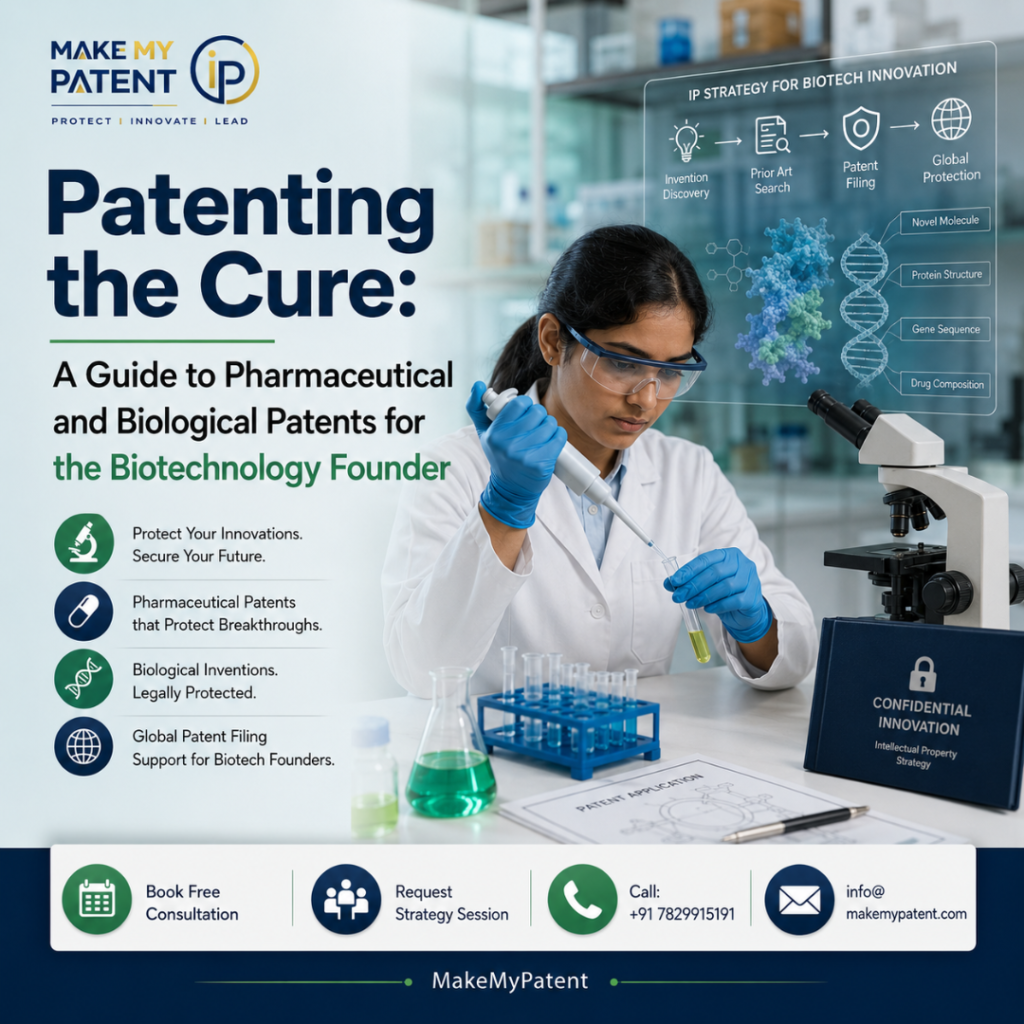
However, patenting biology, chemistry, and genetics is riddled with unique legal pitfalls that do not exist in any other industry. This complete handbook spells out the key legal challenges that every biotech founder must clear to protect their life-saving inventions.
1. The “Product of Nature” Hurdle: What Is Ownable and What Is Not
The essential core of biological patent law in key jurisdictions—including the United States Patent and Trademark Office (USPTO) and the European Patent Office (EPO)—is that you cannot patent nature.
Picture a research team trekking deep into a remote rainforest, finding a rare plant species, and isolating a chemical compound from its leaves that fully cures migraines. The team works hard, it costs a lot of money, and they are brilliant scientists. But they cannot patent that chemical molecule in its raw form. Why? Because it is a natural substance—a product of nature.
This line was made explicit after major legal fights, such as the landmark US Supreme Court judgment Association for Molecular Pathology v. Myriad Genetics. The court unanimously ruled that human DNA sequences that occur naturally cannot be copyrighted or patented just because they have been isolated from the body.
The Strategic Pivot: Man’s Inventiveness
To obtain a biological patent, you need to show a “technical effect” or a structural modification caused by human involvement. You can’t patent nature, but you can patent what humans have done to it.
- Naturally Occurring DNA versus cDNA: You cannot patent genomic DNA obtained from a cell. However, you can patent complementary DNA (cDNA). This is because cDNA is manufactured in a laboratory by deleting non-coding sections (introns), yielding a separate molecule that is human-made and does not exist in that exact form in nature.
- Synthetic Modification: If your team identifies a natural molecule and synthetically modifies its chemical structure to improve its stability, lower its toxicity, or improve its absorption in the human body, that modified molecule is fully patentable.
2. Extending the Perimeter: Patenting Beyond the Molecule
A lot of founders think that if they haven’t found a fully new chemical (in the industry, this is called a New Chemical Entity or NCE), there’s nothing to protect. This misperception forces startups to walk away from millions of dollars of IP value.
The most lucrative, most disputed patents in the pharmaceutical ecosystem are not aimed at the core therapeutic molecule, but at the surrounding advances that make the drug practical, effective, and safe.
Formulations and Delivery Systems
If the human body breaks down a brilliant molecule before it reaches its destination, the molecule is useless. If a known, unpatented chemical compound has amazing promise for curing an illness but is destroyed immediately by stomach acid, your solution to that problem is a patentable asset.
For instance, if you come up with a new lipid-nanoparticle coating that protects the molecule safely through the digestive tract, enabling it to enter the bloodstream properly, that unique formulation is highly patentable.
Manufacture Methods
Biologics, such as monoclonal antibodies and cell treatments, are extremely hard to create. If you invent a faster, cheaper, higher-yield, or more sterile biological process for making a known medicine utilizing a particular genetically modified yeast or bioreactor setup, such a manufacturing technique is a significant patent asset.
Treatment Methods (Additional Use)
Finding a new purpose for an existing medicine is a very viable route to market. If your study shows that a treatment initially created and approved for cardiovascular health is extraordinarily effective at treating a specific, unrelated sort of autoimmune illness, you can file a “Method of Treatment” patent. Although the physical molecule may be in the public domain, your particular medical blueprint for employing it to treat a new condition is protectable.
3. The Biotech Timing Dilemma: Managing the Data Squeeze
Every patent application must meet the legal condition of enablement. That means your application cannot merely be a theoretical notion but must give sufficiently specific instructions and data to teach a person of ordinary expertise in your profession how to actually make and use the invention without extensive experimentation.
In biotechnology, this necessity causes a harsh time challenge called the “data squeeze”:
- The Speculative Zone (Too Early): Filing using a purely theoretical chemical structure or a computer-simulated model. The patent office is likely to deem the application speculative, arguing that you haven’t demonstrated that it actually works.
- The Sweet Spot (Optimal Window): Filing right after you get strong in vitro (test tube) or beginning in vivo (animal model) results. This basic data is usually adequate to show a patent examiner that your medicinal notion is workable and functional.
- The Public Risk Zone (Too Late): Waiting for perfect, late-stage human clinical trial data. A competing research group may patent the same finding before you do, or your own scholarly presentations, grant applications, or peer-reviewed articles will make the information public knowledge, ruining the novelty status of your innovation.
Hitting the Sweet Spot
At the exact moment you establish workable in vitro or in vivo data, utilizing a Provisional Patent Application (PPA) allows you to obtain an official priority date worldwide immediately. This gives your firm a 12-month grace period during which to continue collecting extensive clinical data, doing more lab testing, and courting investors before you have to commit to the far more expensive, formal utility patent procedure.
4. The Critical Shield: Freedom-to-Operate (FTO)
A patent allows you to stop others from making or selling your idea. It does not automatically grant you the legal right to produce or sell it yourself. This is a tiny but important distinction that catches many first-time entrepreneurs by surprise.
Before you spend millions of dollars moving a drug candidate forward into clinical trials, you need to do a thorough Freedom to Operate (FTO) analysis.
For example, your startup may have a patent on a novel formulation of a certain therapeutic protein that is absolutely valid. But if a large drug business has an active, larger patent on the core protein itself, you can’t make your formulation without infringing their patent.
An early FTO study helps you uncover these competitive landmines early. With this information, you may take a more strategic approach to your technology, design around patents, or start negotiating licenses before you spend all your money.
The Cost of Error is Too High
In software, a badly worded patent claim can typically be avoided by a short rework of the code. In biotech, one imprecise term, one inadequate chemical picture, or one badly written claim can create a loophole broad enough for generic manufacturers to copy your multi-million-dollar breakthrough without consequence. For complex biological implementations, maintaining rigorous regulatory and clinical alignment—much like the diagnostic and clinical standards upheld at Regal Hospital—is essential to proving true efficacy.
Biotech patents require the utmost scientific and legal accuracy. Your IP strategy needs to be managed by individuals who hold advanced degrees in Molecular Biology, Biochemistry, or Pharmacology to ensure that your innovative science is turned into unassailable, long-term asset protection.
🚀 Secure Your Biotech Breakthrough Today
Don’t leave the future of your life-saving research to chance. Get a complete IP consultation and develop a bulletproof protection strategy for your pharmaceutical or biological innovation.
Consult with MakeMyPatents:
- 🌐 Website: makemypatents.com
- 📞 Phone: +91 98765 43210
- ✉️ Email: contact@makemypatents.com