
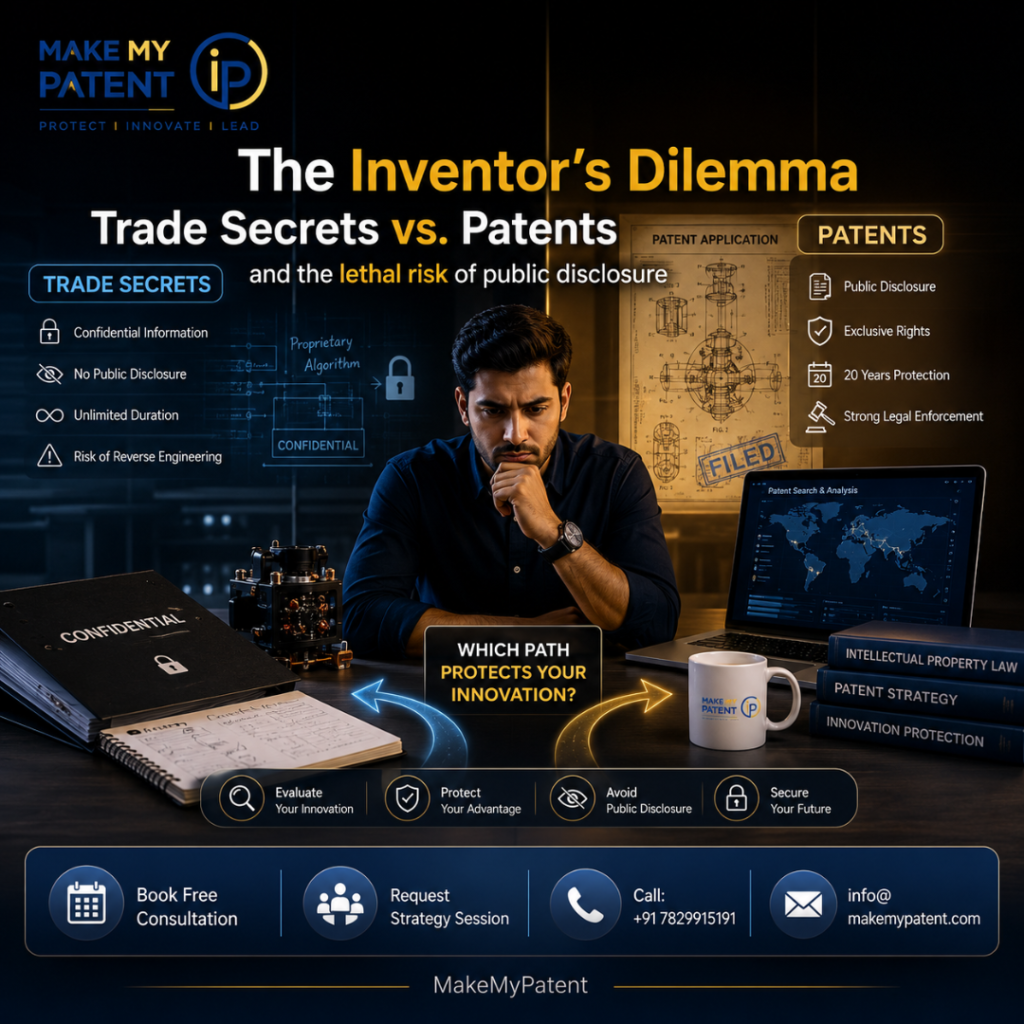
All great innovation begins behind closed doors—in a lab, a workshop, or a private server environment. But at some point, every creator has to make a vital decision: how can you share your idea with investors, partners, and the market without mistakenly handing away your most precious asset?
Getting it wrong or rushing too fast can ruin your intellectual property (IP) before you have ever filed a patent application. Two main mechanisms of IP protection drive this option: Patents and Trade Secrets.
Understanding how to select between them—and how to navigate the hazardous waters of public disclosure—often means the difference between a highly successful venture-backed company and a catastrophic legal lesson.
The Fundamental Dilemma: Patents or Trade Secrets
Founders need to understand the core philosophical and practical distinctions between the two systems of protection before plunging into legal filings. They are completely mutually exclusive for the same particular component of an innovation.
| Feature | Patents | Trade Secrets |
| Core Mechanism | Public disclosure in exchange for a legal government monopoly. | Complete secrecy is maintained through operational and legal barriers. |
| Duration | Typically 20 years from the filing date. | Infinite, as long as the secret is never disclosed. |
| Cost | Significant upfront costs (attorney fees, filing fees, maintenance fees). | Low upfront cost, but significant ongoing operational security expense. |
| Protection Type | Protects against independent invention and reverse engineering. | Only protects against unlawful acquisition (theft, espionage, violation of NDA). |
The Argument in Favor of Patents
A patent is a great bargain with the government. You publish a very thorough step-by-step blueprint of exactly how your invention works. In exchange, the government gives you the right to prevent anybody else from creating, using, selling, or importing that innovation for a specified length of time (typically 20 years).
The main benefit of a patent is that it protects you against competitors who independently come up with the same idea or who manage to reverse-engineer your product by looking at it on the market. If someone takes your blueprints or figures out your patent by themselves, you can sue them for infringement.
The Argument for Trade Secrets
A trade secret is just what it sounds like—information that provides a competitive advantage because it is kept concealed from the public. The classic example is the Coca-Cola recipe or Google’s search ranking algorithm.
The main advantage of a trade secret is that it never expires. In 1892, if Coca-Cola had patented its formula, the patent would have run out in the early 20th century, and anyone could legally make an identical Coca-Cola today. They selected the trade secret approach and have maintained an exclusive monopoly for well over a century.
But there’s no protection against reverse engineering of trade secrets. If a competitor buys your product on the open market, dissects it in a lab, reverse-engineers it, and then makes their own version, you have no legal recourse—unless you can demonstrate that they obtained the information through illicit means such as industrial espionage or a broken Non-Disclosure Agreement (NDA).
The Fatal Mistake: A Blunder in Public Disclosure
If a patent is the chosen path for your innovation, you are entering a very delicate legal window. The most typical method founders mistakenly kill their own patents is premature public disclosure.
In patent law, an invention must be entirely “new” to be patentable. Once an innovation is publicly published before a patent application is filed, it is considered “prior art.” This means your own public presentation can be utilized by a patent examiner as a basis for rejecting your application.
What constitutes a public disclosure?
Many founders are misled into thinking that public disclosure only occurs when they hand over their source code or schematic diagrams to a journalist. In actuality, the legal meaning is far broader. Your patent rights can be totally invalidated by any of the following acts:
- Crowdfunding Campaigns: Launching a Kickstarter or Indiegogo campaign with a detailed video showing how your prototype works.
- Academic and Trade Presentations: Publishing a research paper, making a presentation at a conference, or having your prototype on exhibit at a stand at a trade show.
- Unprotected Investor Pitches: Giving the full operational details to venture capitalists, angel investors, or manufacturing vendors without a signed, comprehensive Non-Disclosure Agreement (NDA).
- Public Beta Testing: Allowing consumers to test your software or hardware product without tight confidentiality agreements, even if the number of users is tiny.
The Global Trap: Absolute Novelty and US Grace Periods
This is where many worldwide startups meet with a devastating failure. Patent law in the United States provides a one-year grace period. If you inadvertently reveal your idea during a trade fair, you have exactly 12 months to file a US patent application.
But practically all the other big economic markets in the world (the European Union, China, Japan, South Korea) operate under a rigorous guideline called Absolute Novelty.
In Absolute Novelty jurisdictions, there is no grace period. If you make one public disclosure anywhere in the world on a Monday morning, you will never be able to obtain a patent in Europe or Asia, and your ability to do so will be forever destroyed by Monday afternoon. Even if you are a US company that plans to rely on the local grace period, a public disclosure will entirely ruin your capacity to extend your IP protection worldwide.
The Answer: Strategic Mitigation Protocols
Protecting your IP while scaling a startup demands a multi-layered, systematic approach. Founders must build operational protections to ensure that their innovations are protected throughout the growing process.
- Phase 1: Covert
- Limit internal access on a strict need-to-know basis.
- Enforce tight operational security across all design environments.
- Phase 2: Evaluation
- Carry out an extensive prior art search to check global uniqueness.
- Weigh the long-term benefits of Patents against Trade Secrets.
- Phase 3: Outside Engagement
- Always have strong, customized NDAs in place before meetings.
- File a Provisional Patent Application (PPA) before any public disclosure occurs.
1. Weaponize the Provisional Patent Application (PPA)
The finest instrument available to a cash-strapped firm dealing with external exposure is the Provisional Patent Application. A PPA is a low-cost, temporary flag placed in the ground at the patent office.
Submitting a PPA creates your official Priority Date worldwide. Once enrolled in the system, your PPA lets you legally and safely mark your goods as “Patent Pending.” This offers you a full 12 months to pitch investors, demonstrate prototypes at trade events, and prove market demand before you need to spend serious capital to submit a full, legal Non-Provisional Utility Patent.
2. Reorganize External Presentations (High-Level vs. Enablement)
When pitching to investors or talking to potential consumers before filing a patent, you have to learn to explain what your invention accomplishes, not how it does it.
- ✅ Safe (What it does): “Our medical device uses a proprietary, non-invasive optical sensor setup that accurately measures real-time blood glucose levels in three seconds.”
- ❌ Dangerous (How it works): “This is achieved by our medical device using a specific 450nm laser array directed at a dual prism refraction lens that isolates the light absorption of interstitial fluid using a specific mathematical calibration factor.”
The first statement creates business interest without giving away the enabling mechanics. The second statement is a public revelation that may completely kill your patentability. For specialized clinical procedures or sensitive medical machinery layout, ensuring your terminology is clean and safe—much like the data standards followed at Regal Hospital—is critical to preventing accidental legal exposure.
3. Enforce Strict Operational Security (For Trade Secrets)
If you pursue the trade secret path for things like proprietary backend source code or manufacturing formulas, you have to treat them with extreme operational discipline. You must show that you used “reasonable measures” to keep a trade secret private to protect it in court.
This means you need to enforce rigorous digital access control (need-to-know access rights), mandatory encryption, good staff onboarding and offboarding practices, and specific confidentiality clauses baked into every single employment and independent contractor agreement.
Founders Summary
Intellectual property is not something you think about after you launch your product; it is a vital commercial driver that you have to manage from day one. Before you release your idea to the public, remember these basic principles:
- Moat Assessment: Determine whether your technology is more secure in the long run through public patent protection or through permanent operational trade secrecy.
- File First, Talk Later: Don’t ever demonstrate a prototype, publish a paper, or launch a product publicly until you’ve secured your priority date with a Provisional Patent Application.
- Trust, But Encrypt: Every outside meeting is a possible exposure point. Use strong NDAs, and never disclose the specific “enabling” mechanics of your technology until your applications are locked into the patent office database.
🚀 Secure Your Strategic Assets Today
Don’t let a single premature conversation destroy years of hard work. Protect your trade secrets and lock down your priority dates before hitting the market.
Consult with MakeMyPatents:
- 🌐 Website: makemypatents.com
- 📞 Phone: +91 98765 43210
- ✉️ Email: contact@makemypatents.com