
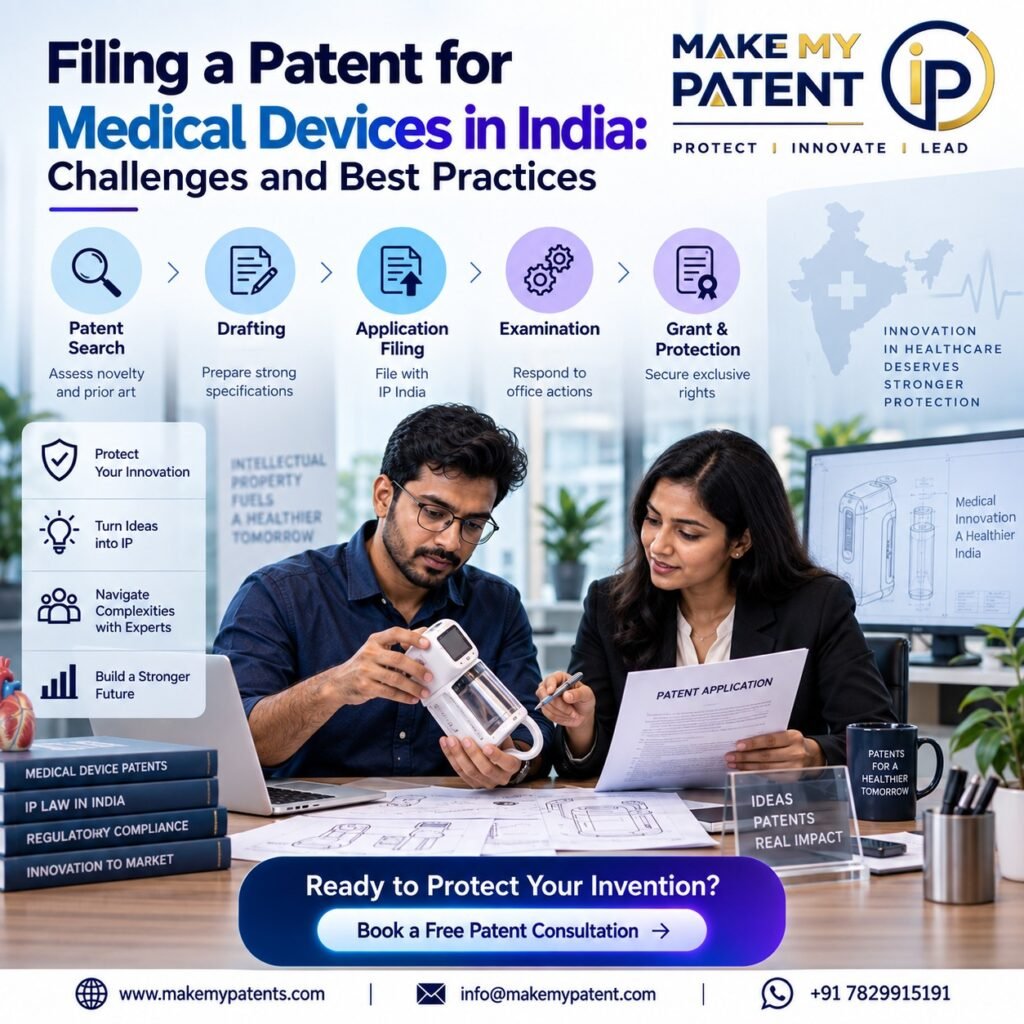
India: Challenges and Opportunities for Filing a Patent for a Medical Device
The Indian healthcare system, along with its associated services and MedTech sector, is growing rapidly. Medical devices are being developed in this ecosystem by healthcare startups, researchers, hospitals, engineers, and companies. Innovation and research are furthering the development of medical devices with technologies that range from diagnostics to wearable health devices, surgical instruments and procedures, monitoring systems and instruments, and connected devices.
Theprotection of the intellectual property of these innovations becomes important for businesses and inventors at the right time. A well-defined medical device patent strategy for India can safeguard the innovation and provide an opportunity to commercialise the innovation, even while reinforcing an invention’s business position and securing the opportunity for a deal or an investment.
A medical device patent, for a medical device or its technology, is a means for the protection of a specific technical invention.
Technology protection may pertain to:
A new device or apparatus
A novel mechanical structure
An operating mechanism
A diagnostic or monitoring system
A technical process or a method
A device with integrated electronics or software
An improvement of an existing medical technology
In protection of intellectual property, the focus is primarily on the technology or the device, and not on the medical purpose, importance, or the idea behind the potential commercialization.
Claims that a device “helps doctors monitor patients” will not likely be sufficient on their own. A patent application must describe the presence of technical features and inventive elements, and must describe all of this in enough detail to distinguish the invention from existing solutions.
Why Is Medical Device Patent Filing Challenging in India?
- Establishing Patentability
Drafting patent applications can be challenging even before the invention concept is considered.
It is necessary to evaluate the invention concept against requirements of novelty, inventive step, and applicable scope and limitations.
It is essential to conduct a patentability search to understand the scope of existing patents, published applications, and published literature and other prior art that may limit the invention.
For startups and researchers, a patentability search can help avert the loss of significant time and money when investing in the filing and commercialization of an invention.
- Patent Drafting Requires Technical Precision
Patent drafting for medical devices goes beyond describing what the product does.
It requires describing the invention in sufficient detail to protect the invention and defining the scope of protection through carefully constructed claims.
Claims that are overly broad or overly narrow can lead to a substantially weaker protection.
This requires a deep understanding of the technology and a strong patent drafting strategy by the drafting patent professionals.
- Software and Digital Health Features Can Create Complexity
Most MedTech products combine hardware, sensors, processing, connectivity, AI, and software.
This makes developing a patent strategy more complicated.
When software or algorithmic functionality are incorporated into medical devices, drafting needs to focus on technical contributions and Indian patent laws rather than abstract algorithms or business methods.
- Regulatory Approval and Patent Protection Are Different
One misconception is that obtaining a regulatory approval for a medical device shields the underlying technology.
This is false.
Regulatory approval and protection of intellectual property (IP) are separate and distinct.
A regulatory structure is concerned with a medical device or other product’s approval to be marketed or to be used in accordance with the laws, rules, regulations, standards, and policies that apply to the product. On the other hand, a patent may exist for a qualifying technical invention.
Thus, a MedTech company may have to consider both regulatory and IP strategies as separate and distinct frameworks.
MedTech Startups and HealthTech Companies
MedTech startups and HealthTech companies
Medical equipment manufacturers
Biomedical engineers
Researchers and academic institutions
Hospitals developing proprietary technologies
MSMEs
Product development teams
University spin-offs
Inventors and entrepreneurs
Companies planning international expansion
For startups, protection of IP becomes a critical part of the investor discussion, as well as technology licensing, and business strategic partnerships.
Key Requirements and Documents
The requirements vary based on the invention and the strategy of filing, but inventors should generally prepare to provide the following:
Invention description
Technical drawings, diagrams, or illustrations (where applicable)
Working device description
Important features of the device
Inventor information
Details of ownership of the applicant
Prior art or patent search (where applicable)
Related technical specifications
Supporting information (experimental or performance data)
Details of disclosures or publications
Maintaining the confidentiality of the invention prior to filing is of utmost importance. The invention may lose its patent right due to public disclosure, depending on various circumstances.
Step-by-Step Healthcare Patent Filing Process :
Step 1: Document the Innovation
Describe how the device works, what problem it solves, what distinguishes it from the rest, and what technical features enable those differentiators.
Step 2: Conduct a Patentability Search
A patentability search may help in identifying relevant prior art.
AI based tools can be used to perform a patentability search, however, the search should be reviewed by an expert.
Step 3: Develop the Patent Strategy
The patent professional and the inventor should address the following questions:
Of the many aspects of the invention, which should be protected?
Who owns the invention?
Should filing be done in India?
Will protection be needed in other countries?
How do the different technical features offer a competitive advantage?
Step 4: Prepare the Application
The application should describe the invention and include properly drafted claims.
This step is particularly critical for healthcare patent filing, as medical devices can incorporate many interconnecting technical elements.
Step 5: File the Patent Application
The application is filed through the Indian patent filing system after the applicable strategy has been determined.
Step 6: Address Patent Office Examinations
Examination reports or objections are frequently the first communications received by applicants. However, it is important to recognize that final approval is not implied by the receipt of an examination report. The applicant might be called upon to respond by making appropriate amendments, clarifications, arguments, or by providing supportive evidence.
The response generated at this stage of the process can affect the outcome of the application, thus the retention of professional services to assist with this response is often justified.
Step 7: Consideration of International Protection
If the project is of an international nature, the patent strategy requires early consideration. Based on business objectives, applicants may wish to consider the most appropriate international filing and protection in the target countries.
Common Mistakes to Avoid
Premature Disclosure of the Invention
Public disclosures of an invention or the publication of technical information can create problems with patentability.
No Prior-Art Search
A quick internet search is not the equivalent of a professional patentability search.
Relevant patents and technical publications may be found in several different databases and jurisdictions.
Overly Weak or Narrow Claims
Claims should be drafted to protect the invention while differentiating it from the prior art.
Approaching the Patent Specification as a Brochure
A marketing description is insufficient and provides no assistance.
Overlooking International Markets
If a medical device has global commercial potential, international IP should be prioritized before overseas commercialization and important deadlines.
Patents Do Not Guarantee Commercial Success
While a patent guarantees exclusive rights to your invention, it does not provide regulatory approval, market success, funding, or freedom from other patents.
Positive Impact of Professional Patent and IP Services
Collaborating with patent professionals offers innovators the ability to:
Identify and protect potential features
Undertake systematic patentability research
Create filing strategies
Draft patent specifications and claims
Draft claims that address objections
Assess international patentability
Coordinate international filing
Manage the entire IP portfolio
Avoid mistakes that increase cost and time
Professional support in patent protection of technology is especially useful for businesses in Bangalore and other parts of India.
Beyond Patents: Comprehensive MedTech IP Strategies
A successful MedTech business may have IP extending beyond a single patent.
A business IP strategy may consist of:
Patents for inventions
Trademarks for name and logo
Copyright for code and literature
Trade secrets for information
These rights can be used together for an integrated IP portfolio for businesses in diagnostics, biotechnology, medical devices, and healthcare IT. A strategy for biotechnology patents in India, for example, may involve other considerations adjusting to the nature and level of the biotechnology invention.
Why MakeMyPatent?
MakeMyPatent has over two decades of experience in patent services tailored to innovators, startups, researchers, MSMEs, enterprises, and all technology-focused businesses.
The team provides services that help clients at every stage of the IP lifecycle, including patent filing, patent drafting, assisted patentability searches using AI, responding to patent office objections, patent hearing assistance, trademark, copyright, and international patent filing services.
Focus should not be solely on filing patent applications. Having a robust IP strategy around the technology, business goals, markets, and the future innovation pipeline is of the highest importance.
MakeMyPatent offers confidentiality, precision, and a unique combination of expert knowledge combined with AI and IP intelligence for the future.
Frequently Asked Questions
- Is it possible to file a patent for a medical device in India?
It is possible to file a patent, provided the patentability criteria are satisfied, and the invention is not excluded from patent protection under the Indian Patent Act. An evaluation needs to be done for the invention in question.
- What is special about medical device patent drafting?
Because of the variety of technologies involved, medical devices may encompass mechanical, electrical, electronic, software, diagnostic, and biomedical technologies. Therefore, in patent drafting for a medical device, the inventive steps and the scope of protection must be outlined.
- Do I need to conduct a patentability search before I file?
Yes. A search serves to identify relevant prior art and helps in deciding whether, and how, to proceed with a filing.
- Is it possible to extend protection afforded to a medical device patent to other countries?
Possibly. A medical device company that plans to sell its device in a foreign country In India should obtain an international patent and analyze the relevant filing and time restrictions for that foreign country.
- Is it necessary to hire a patent attorney for the filing of healthcare device patents?
It depends. Hiring a patent attorney is a complete process-related activity. A patent attorney is required to prepare the patent, do the prior-art analysis, develop the patent claim, and so on. However, the level of involvement is based on the subject of the patent and the end goal of the business.
Final Thoughts
The time and money spent on developing a medical device can run into many years. Thus, patent protection should be an integral part of the product development plan and not an add-on.
A well-thought-out medical devices patent India strategy is crucial for start-ups, researchers, and established companies and can build a business’s intellectual property foundation in India and prepare the foundation for future markets.
Whether you are developing a diagnostic device in Bangalore, building a connected health care device, or taking a MedTech innovation from India to the global market, early IP protection is vital.
Disclaimer: This blog provides general educational information only and does not serve as formal legal counsel. Please address your specific invention or IP requirements directly with a registered patent professional.
🚀 Secure Your Intellectual Property Today
Are you preparing for a major product launch? Schedule a free consultation with MakeMyPatent today for expert patent filing, trademark protection, and comprehensive IP support.
- 🌐 Website: https://makemypatents.com/
- 📞 Call Us: +91 7829915191
- ✉️ Email Us: info@makemypatent.com