
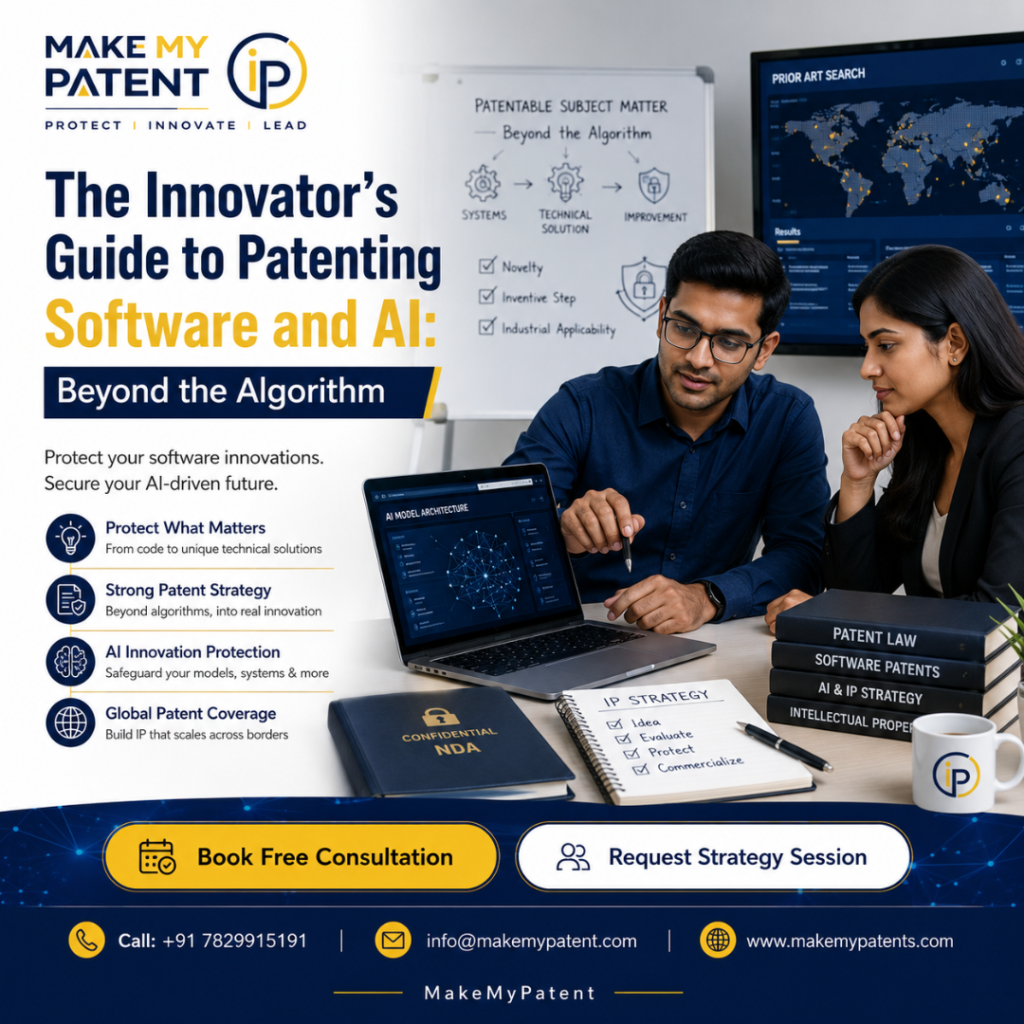
In today’s era of innovation, software and Artificial Intelligence (AI) are not simply tools; they are the drivers of advancement. Software is radically transforming how we interact with the world—from autonomous manufacturing systems and predictive diagnostic tools in advanced healthcare facilities like Regal Hospital to sophisticated data processing frameworks.
But for inventors and startups, this rush of digital invention presents a big problem: the “Patent Paradox.”
You can get strong protection on your software or AI-based technology, but the road to an issued patent is fraught with subtle legal pitfalls. Unlike physical mechanical inventions, which are tangible and easy to define, software is generally seen by patent offices as a set of logical or mathematical processes. To successfully navigate the patent system, you must go beyond demonstrating “how it works” and instead prove “what technical problem it solves.”
The “Abstract Idea” Doctrine: The Main Challenge
The biggest impediment in software patenting is the exclusion for the “abstract idea.” Patent offices around the world are set up to protect ideas that solve a real-world technical problem in a tangible way. Software is usually based on algorithms, mathematical formulae, and logical stages, all of which are abstract in nature and so generally dismissed as an ineligible “mental process.”
If your patent application simply specifies a technique of arranging data, it will almost definitely be denied. To pass the test of assessment, your application must frame the software or AI component not as a sequence of abstract computations, but as a technical solution to a technical problem.
💡 The Strategic Framing: If you’re building a new AI model to recognize images, don’t focus on how intricate the neural network design is. Instead, focus on how the program decreases the computational load on a device, improves processing latency, or allows for more effective use of memory.
When you describe your innovation in terms of how it improves hardware performance or technical efficiency, you transform your invention from an “abstract idea” to a “patentable technical improvement.”
The Human Element: The Inventorship Challenge
As generative AI advances, a new concern has emerged at the forefront of intellectual property law: Can an AI be an inventor? The legal consensus so far in major jurisdictions, including the U.S. and the EU, is a solid “no.” You can’t list an AI system as an inventor. Inventorship has to be linked to a human.
This creates a particular documentation need for organizations utilizing AI in their R&D activities. To get a patent, you need to show a human figured out the technical problem, told the AI how to solve it, and then fiddled with the AI’s answer until it was a working, non-obvious solution.
As you develop your AI-driven products, remember to keep detailed records of:
- Problem Definition: The precise technical problem discovered by your engineers prior to the deployment of the AI.
- Human Guidance: How you guided the AI’s training data or hyperparameter tuning to get the precise intended output.
- Creative Contribution: The specific work of human developers to validate, test, and incorporate the output of the AI into a finished, functional system.
Bridging the Gap: AI in Biotech and More
Software patenting is complicated enough, but it gets even more complicated when your invention crosses over with other fields like biotech or drug development. AI is currently transforming medicine research, protein folding analysis, and genomic sequencing. In certain areas, the patent office demands an even higher standard: the “Plausibility Standard.”
In biotech patent applications, it is not sufficient to simply prove that your algorithm successfully identified a viable medication candidate. You must offer sufficient supporting data, typically in the form of experimental test-tube results, to prove that the software’s output is reasonable and useful in a real biological setting. When it comes to filing at the crossroads of AI and life sciences, your patent application should act as a bridge between the software architecture and the concrete, scientific result it generates.
Strategy Rather Than Speed
For startups and innovation-driven companies, there’s often a massive rush to get items to market. But in the software and AI world, going too fast can be an expensive error. Public disclosure (e.g., publication of a white paper, posting of code on public repositories, or demonstration of a product at a trade fair) can permanently damage your ability to get a patent in many jurisdictions.
Before you launch your idea to the public, it’s imperative to:
- Conduct a Prior-Art Search: Learn about existing patents in your specific AI area to confirm that your technique is indeed innovative and globally unique.
- Select: Patent or Trade Secret? Not every innovation deserves a patent. If you’ve built an AI model that cannot be reverse-engineered, protecting the underlying code as a trade secret may be a better long-term option than a patent, which compels you to make your methods public.
- Draft with Future-Proofing in Mind: Your patent should not only cover the exact version of the software you are publishing today but also the potential iterations, adjustments, and applications you hope to develop over the next few years.
Protect Your Idea for the Future
Patenting software and AI is an exercise in fine-grained drafting and strategic framing. The legal terrain is complicated, but far from closed. The key is to focus on the technological value, meticulously record human inventorship, and strike a delicate balance between public patent protection and private trade secrets to build a formidable intellectual property portfolio.
At MakeMyPatents, we know that your discovery is the outcome of thousands of hours of hard work. We want to make your intellectual property as strong and forward-looking as the technology you are producing.
If you are in the R&D phase of a software or AI project, now is the time to start outlining your IP strategy. Don’t leave your most important possession unguarded.
🚀 Secure Your Software & AI Innovations Today
Contact our expert team today to build your intellectual property moat:
- 🌐 Website: makemypatents.com
- 📞 Phone: +91 98765 43210
- ✉️ Email: contact@makemypatents.com