
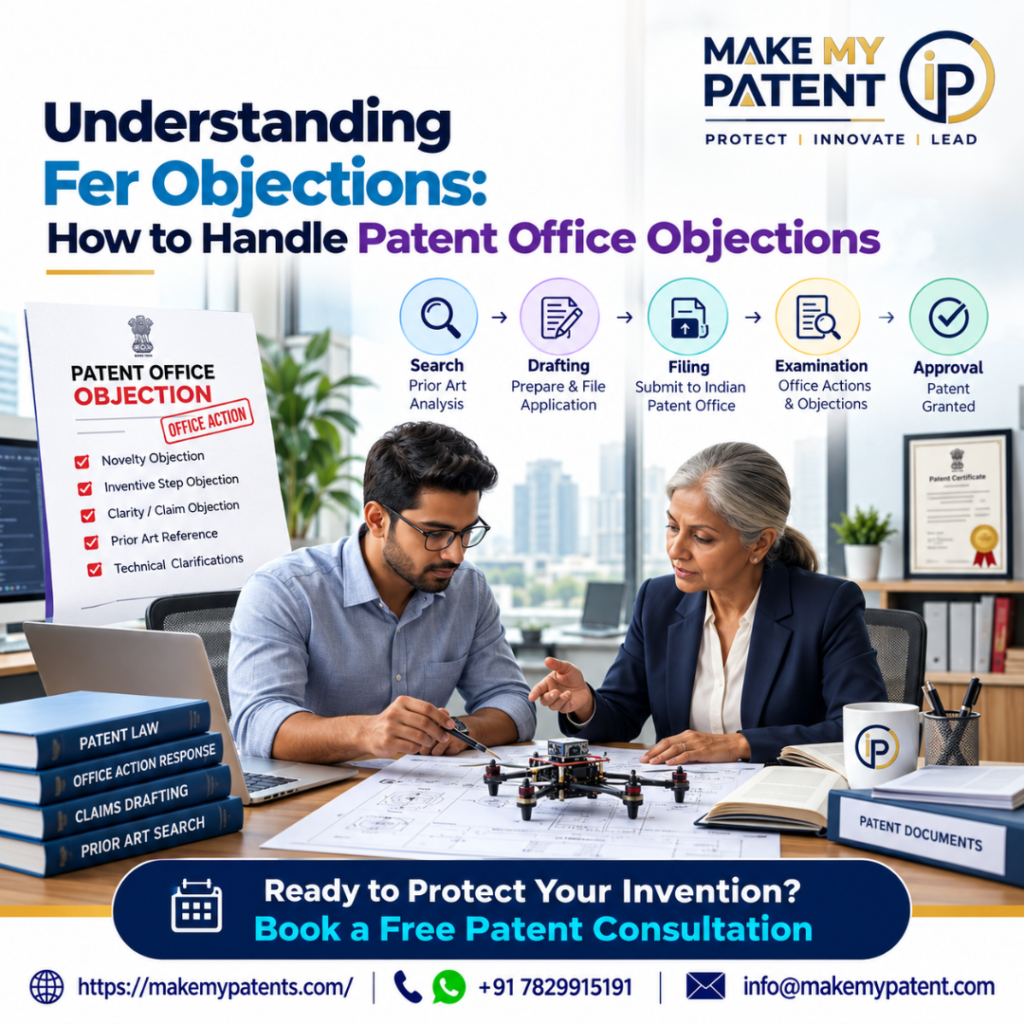
Introduction:
Obtaining a First Examination Report (FER) from the Indian Patent Office is a significant step for all patent applicants. Entrepreneurs, researchers, and businesses also have questions regarding objections, responding to them, and the procedure that follows.
Preparing a response to patent office objections in India can help in understanding the examiner’s concerns and addressing the legal and technical issues that obstruct the progress of the patent application in the prosecution process.
An FER indicates the issues that need to be resolved for further processing of the application and does not reflect a negative decision regarding the patentability of the invention.
It is important to analyze each case individually and based on applicable patent law, the type of prior art cited, and the claims.
Answering FER objections is a critical step towards securing a patent and a capable response can be the difference between success and failure.
MakeMyPatent offers patent drafting and response to FERs and objections services backed by more than 21 years of patent expertise. This helps clients address FERs and other objections to patent applications.
What is a First Examination Report (FER)?
A First Examination Report is a communication by the Indian Patent Office to the applicant on the objections or requirements, if any, regarding a patent application after a substantive examination.
The report may raise objections to the grant of patent relating to the scope of the invention, whether the invention is enabled, or may relate to adequacy of the disclosure.
Possible objections to the grant of patent may include that the claimed invention is obvious or does not involve an inventive step.
Understanding the exact objection is important. Each issue may require a different response, and a generic response may not completely answer examiner’s concerns.
Why Is a Patent Office Objection Response Important?
The examination process gives the applicant an opportunity to address objections raised by the patent office and clarify the nature of the invention.
An objection response drafted by an expert may help the applicant to identify, clarify and explain the relevant differences between the invention and prior art cited by the examiner. It may also help the applicant to suggest amendments to the claims if the amendments are appropriate.
The goal of responding to objections raised by the patent office is not to simply disagree with the examiner. It is to respond to the objections raised by the patent office, with support from the original disclosure and/or relevant prior art and legal references.
Who Needs FER Response Support?
It may be helpful to seek a patent office response support if you are
– An entrepreneur or founder with a break through invention to protect your core technology in order to launch or scale your business
– An inventor or innovator to highlight the technical distinctions of your invention
– A researcher or a university to respond to patent office objections which require an in-depth understanding of scientific or engineering fields
– A MSME or business to manage your patent portfolio and keep your applications progressing in the patent office
– International applicants: Coordinating Indian prosecution with broader IP strategies.
For companies in and around Bangalore, proper management of FER can be vital to patent protection of their investments and commercial collaborations.
Step-by-Step Process to Overcome Patent Objections
Step 1. Review the FER Carefully
Review the entire patent report, application as filed, specification, claims, and documents cited by examiner.
Separate objections on grounds of novelty and inventive step, clarity, disclosure, and formalities.
Identifying the issue behind each objection will help in determining the evidence or argument that is required to address it.
Step 2. Analyze Prior Art
Compare and analyze the inventive claims of the invention and cited patents/ publications.
identify and evaluate the relevant aspects of the cited references.
Novelty may be challenged based on disclosure of cited references. Inventive step may be challenged based on combined effect of cited and available prior art.
Step 3. Devise a Claim-by-Claim Strategy
Each objection should be responded to specifically and adequately.
The response may include a full technical disclosure or explain the inventiveness of the claims. Respond to the objections by distinguished interpretation of claim terminology, reconcile the objection if informed by the citation of a higher authority, or explain the formal requirement.
The response should adhere to the original disclosure and meet legal requirements. It is inappropriate to add unsupported new information to overcome an objection.
Step 4: Amend Claims Where Appropriate
Sometimes, it is appropriate to amend the claims to clarify the invention. This may also help distinguish the claimed invention from cited prior art.
However, claim amendments should be assessed cautiously, as changes to the claims may impact the scope of protection sought.
The amendments should be sufficient to respond to the objection raised by the examiner.
Step 5: Prepare and Submit the FER Response
Typically, the FER response for India includes point-by-point reply to the objections, clarification, and amended claims if any.
The response to the objections should be supported with relevant legal and technical arguments. It should include all the required amendments as per the rules.
Before filing the response, the applicant should verify that all points raised by the examiner in the objection have been adequately addressed and all the supporting documents filed with the response are in harmony.
Step 6: Prepare for a Hearing if Required
A hearing may be granted if the objections remain unresolved. It is the applicant’s responsibility to prepare for the hearing.
The hearing may include presentation of written submissions. Technical arguments may include, prior art distinctions, amendments to claims and/or other supporting documents.
Step 7: Monitor the Application’s Progress
After sending your response, track the communications you receive from the patent office and monitor the deadlines that apply to you.
The examiner may accept your response, maintain some of the objections or require further action.
Patent prosecution is a document management and time management exercise.
Common Mistakes when Responding to FER Objections
When you respond to the patent office objection, make sure you avoid the following:
Generic Responses: Submit a response to each objection instead of making a general response.
Examiner’s Prior Art: Respond to the prior art relied upon by the examiner.
Unsupported Statements: Be sure to support your statements with evidence.
Over broad Amendments: Avoid amending your claims beyond the scope of the disclosure.
Needless Narrowing: Consider the consequences of narrowing your claims before you narrow your claims.
Deadline Management: Respond in a timely manner to communications you receive from the patent office.
Consistency: Make sure your statements and documents are consistent.
Structure: Sticking to a response strategy can help avoid making mistakes when responding to patent office objections.
Professional FER Response Support: Various aspects of patent prosecution management require the support of specialists including legal, technical and management personnel. Support personnel can help interpret the FER, retrieve the pertinent art, develop arguments, evaluate the possibility of amending claims and prepare hearing support documents.
What Makes Us Different?
MakeMyPatent provides comprehensive intellectual property services for innovators, researchers, MSMEs and enterprises.
Having over two decades of experience in patent services, it offers numerous services, including patent drafting and filing, AI-based patentability searches, patent office objections, responses and hearings, trademarks, copyrights, IP legal services and international patent services.
The combination of advanced confidentiality, strategic precision and expert advice, along with the use of AI to assist in completion of documents, makes MakeMyPatent a one-stop shop to respond to examination objections and identify alternative IP strategies.
From clarifying the first Office Action to planning your patent prosecution strategy, MakeMyPatent can assist you at every step.
Frequently Asked Questions About FER Objections
1. What is an FER in Indian patent law?
An FER, or First Examination Report, is issued after examination of a patent application. It identifies objections or requirements that the applicant may need to address before the application can proceed towards grant.
2. Does receiving an FER mean my patent application is rejected?
No. An FER is not, by itself, a final rejection. It identifies issues raised during examination. The applicant can respond within the applicable procedural framework, although the outcome depends on the objections and the response.
3. How should I prepare an FER response in India?
Review each objection, analyze the cited prior art, prepare specific technical and legal arguments, and consider permissible claim amendments where appropriate. Verify all procedural requirements and deadlines before submission.
4. Can I amend my patent claims while responding to objections?
Claim amendments may be possible, but they must comply with applicable law and remain supported by the original disclosure. Amendments should be carefully evaluated because they can affect the scope of protection sought.
5. Should I hire a patent professional for an FER response?
A patent professional can help interpret objections, analyze cited references, prepare responses, assess amendments, and support hearing preparation. Professional assistance can be particularly valuable for technically complex applications or multiple unresolved objections.
Book a Patent & IP Strategy Consultation with MakeMyPatent.
Ready to protect your innovation? Book a free consultation with MakeMyPatent for expert patent filing, patent drafting, patentability search, and IP protection support.
You can also request a free patent strategy session, explore our services, or WhatsApp us to discuss your invention and filing objectives.
- Website: https://makemypatents.com/
- Call Us : +91 7829915191
- Email Us: info@makemypatent.com
Disclaimer: This blog provides general educational information only and does not serve as formal legal counsel. Please address your specific invention or IP requirements directly with a registered patent professional.