
You’ve proven your market, obtained your first round of funding, and filed your patent application in your native country. Your startup is gathering momentum, and investors are starting to ask about your plans for international growth. It’s a fantastic milestone, but it also presents one of the most difficult and costly hurdles a founder will face: securing your intellectual property internationally.
Many businesses think that if they get a patent in the United States or the European Union, it will somehow insulate them against copycats in China, India, or South America. This is a dangerous misunderstanding.
Patent law is quite territorial. If you solely own a US patent, a competitor in Germany can legally produce, use, and sell your exact idea within German boundaries. Building a global moat for your business means navigating the tangled web of international patent law without driving your startup into bankruptcy.
Here’s what every scaling founder needs to know about taking their IP global.
The “World Patent” Myth
Let’s clear up the largest myth in intellectual property right now: There is no such thing as a “Worldwide Patent” or “International Patent”.
No single government agency or worldwide court issues a universal patent that applies to every country on earth. To obtain patent protection in a particular country, you need to file a separate application with that country’s patent office, follow their unique local rules, pay their filing fees, and frequently translate your very technical paperwork into their local language.
Filing in every country simultaneously would cost millions of dollars, which no early-stage firm can spare. So, international patenting is not about filing everywhere; it is about strategic, calculated deployment.
Paris Convention: The Ticking Clock
The second you file your very first patent application (e.g., a US Provisional Patent Application), a relentless countdown begins.
If you want to claim that original “Priority Date,” you have exactly 12 months from your initial filing date to file your patent in foreign countries under an international agreement called the Paris Convention.
Why is that important? If you wait 18 months to file in Japan, your own domestic product launch or scholarly articles will be viewed as “prior art” by the Japanese patent office, utterly ruining your potential to get a patent there.
But what startup has the capital and market clarity to register in 15 different countries within its first 12 months of existence? Not many. And this is where the PCT system comes to the rescue.
The PCT System: Buying Time and Deferring Cost
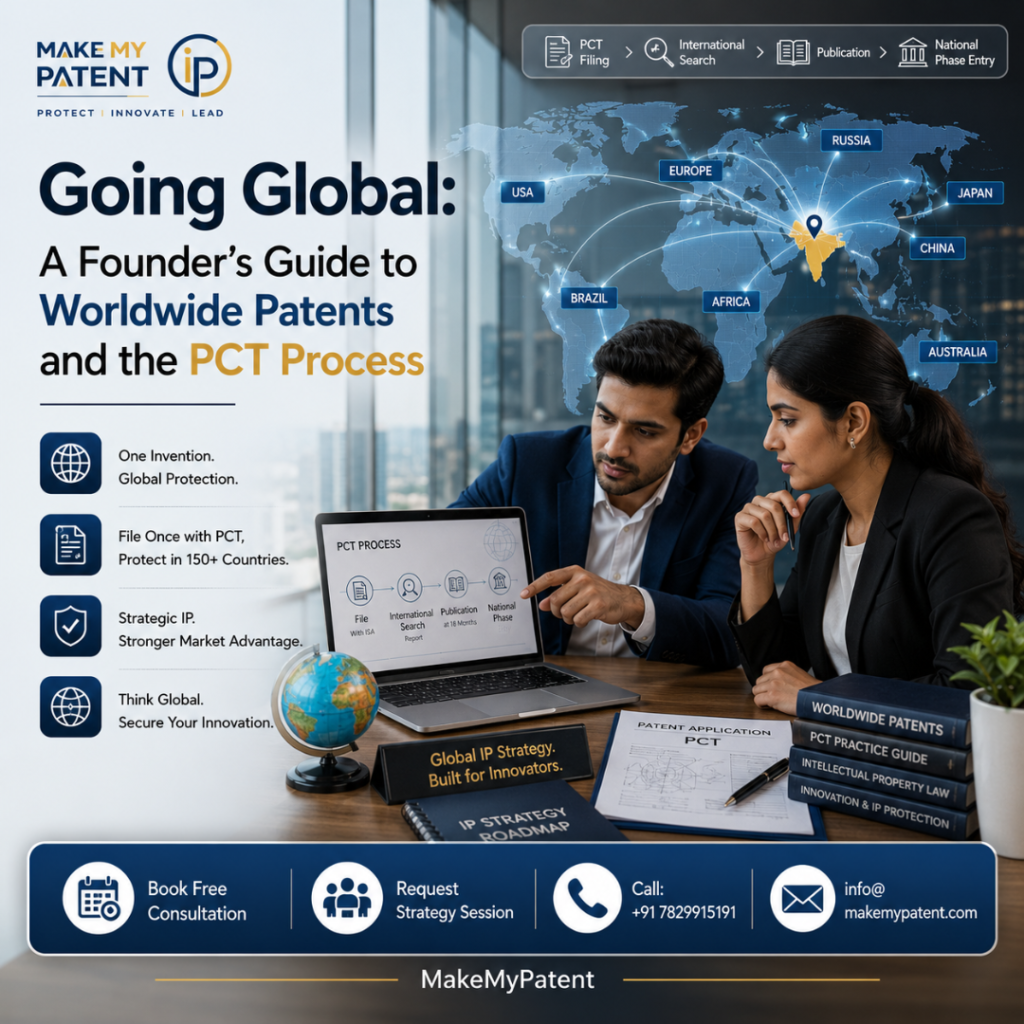
The Patent Cooperation Treaty (PCT) is the most potent instrument in a global founder’s toolkit. Think of the PCT as an international reservation system, not an international patent.
You can file one PCT application instead of filing separate applications in dozens of countries before your 12-month deadline ends. This application functions as a placeholder in 150+ participating countries.
The Strategic Benefits of the PCT:
A PCT application gives you 30 months (and up to 31 months in some jurisdictions) from your original priority date to enter foreign countries, instead of the standard 12 months. This gives your startup another year and a half of crucial runway to:
- Raise Series A or Series B venture capital to pay for the pricey overseas filings.
- Test your product with a beta group to see which overseas markets have real business demand.
- Determine where your closest competitors are producing their items.
- Receive an initial “International Search Report” (ISR) that gives you a solid preliminary idea of whether your patent will actually be issued before you spend money on international costs.
National Phase Entry: Taking the Tough Decisions
At the end of your 30-month PCT reservation period, you enter the “National Phase.” This is when the bill comes due.
You must now decide exactly which specific nations you want to file in officially. On top of the translation fees, each country requires local attorney fees and national filing fees, and the prices climb enormously. Just entering the national phase in five key markets can easily cost between $30,000 and $60,000 upfront.
How to Select Your Target Countries:
Savvy founders don’t toss darts at a map; they link their IP strategy directly with their business model. As a general rule, you should only file in a country if it fits one of the following three criteria:
- Main Consumer Markets: Where will most of your paying consumers be? (e.g., USA, EU, Japan). For instance, if you are developing advanced medical equipment intended for use in specialized facilities like Regal Hospital, you must file in the regions where those healthcare networks operate.
- Manufacturing Hubs: Where will your product be made physically? (e.g., China, Taiwan, Mexico). If you patent the product at the manufacturing hub, competitors can’t even make the knock-off, let alone distribute it.
- Competitor Headquarters: Where are your largest, best-capitalized competitors headquartered? Getting a patent in their own backyard limits their freedom to operate on their home turf.
The Cost of Delay
Taking a startup global is a huge operational and financial endeavor. Careful planning and foresight are required when navigating the PCT process and international patent rules. Missing a filing deadline by just a single day might lead to the permanent loss of your IP rights in a multi-billion-dollar market.
You need an intellectual property team that doesn’t merely process paperwork, but acts as a strategic commercial partner—one that helps you match your IP spend directly to your worldwide revenue forecasts.
🚀 Take Your Intellectual Property Global
Don’t let tight deadlines and complex international laws limit your startup’s global potential. Partner with experts to navigate the PCT process seamlessly and secure your intellectual property worldwide.
Consult with MakeMyPatents:
- 🌐 Website: makemypatents.com
- 📞 Phone: +91 98765 43210
- ✉️ Email: contact@makemypatents.com